I’ve been and gone and done it, then – leased myself some storage space with Big Yellow so I can acquire a whole lot of stock to offload on Ebay, Ebid.net, Amazon and elsewhere. It does feel like quite a commitment, and financially it certainly is exactly that. Not that it was all that expensive – my quote was for an extra free month on top of approximately £50 a month including insurance. Plus a security deposit of one month too. Still, speaking as a LUB – that’s Lazy Unemployed Bum to the uninitiated – it feels right now a bit of a millstone round my neck.
Certainly it means I have to act on it: with an invoice for £50 coming in every month I will need to be out there sourcing stock, photographing it, listing it. And hopefully with that will come all the associated work of extra sales: wrapping, updating listings, posting, keeping accounts.
Of course having this leap into the dark coincide with the credit crunch doesn’t inspire masses of confidence, exactly. But then, there’s always some reason not to take a risk, not to put yourself out there: if it wasn’t the crunch then I’m sure I could come up with a dozen other reasons why now isn’t a good time.
On the day I actually went to take possession and load up the tiny unit with a few boxes, I felt such a massive, sweaty resistance. It was as if every fibre of my being was just trying to hold me back, refusing to budge, shouting, ‘NO!’ It didn’t feel like intuition: it felt like fear. Fear of a huge, irrevocable step – a step that might lead to great things, and maybe that was half the trouble. If I’m not an underachiever, a failure, a LUB – then who am I? How will I recognise myself when I look in the mirror? I’ve read a lot of Barbara Sher and I thought I recognised the feeling from some of her books. It wasn’t trying to protect me. It was trying to sabotage me with the desire for safety and familiarity – even though the familiar can be very unsafe indeed.
But I thought of Goethe – or whoever is in fact responsible for that famous quote, the ‘Boldness has genius, and power, and magic in it,’ one – and pushed through the resistance. Just steadily refused to acknowledge that inner voice, and instead chatted and joked with the guy on reception, filled in reams of paperwork, and… committed myself. Maybe they should have given me a complimentary straitjacket.
Tuesday, 7 October 2014

Wednesday, 29 April 2009
What I should have done to get a 2:1
 Picture used under the terms of the GNU Free Documentation License : please consult before re-use.
Picture credit: Twice25
I've been thinking about this because I wrote an article for EzineArticles on Revision Tips for Slacker Students and that made me consider about how it applied to me. I got a 2:2 a few years back myself, partly due to ill-health but also as a result of a lack of 'smarts'. I was smart, I just didn't have 'smarts', if you see what I mean. I was insufficiently worldly-wise (or college-wise) to pick up on the tricks and tips that leverage your classification up those crucial few points.
So if I could go back in a time machine, what would I do differently? Well, based on the results obtained, I would make vastly more use of my mp3 player (which is a cute little Muvo, half the price of an iPod and does everything I need it to do. It's been dropped, sprayed with water and has skulked around the bottom of my packed handbag for a couple of years now, and yet it still works like clockwork).
Basically I had a kind of a breakdown in my second year – I say kind of, because it amounted to regular, prolonged and very unpleasant panic attacks. These made traditional revision techniques very nearly impossible due to the malaise and fatigue they resulted in even when over. So I had to try something else and hit on the option of recording all my lecture notes onto my Muvo, then just lying in the dark and listening to it. (I realise this isn't exactly a revolutionary method now – or even then – but I hadn't tried it myself). This amounted to, I'd estimate, maybe 70% of my revision for my second year exams.
What were the results? Well, I didn't ace every test, or anything. But I did pass everything, with quite tolerable grades, average-to-good for the most part. Which surprised me, considering my state for half of the year.
What is really interesting is that my mental and physical health was much better in my third year. I considerably reduced my use of this technique as a result, and returned to conventional study methods. And what was the result of that? Errrr, average – not average-to-good, note – results across the board. Except for the one low-credit module I actually failed, but that's a story for the next post.
And that was after a year of working away at much more labour-intensive techniques than listening to my little Muvo. Drat. Kids, it's not an original thought, but sometimes it really is more important to work smart than to work hard. Although working hard, smartly, is the preferred option, always, and the one I recommend to you.
I'll detail my other illuminations on what I should have done to get a 2:1 during my degree course in another post.
Tuesday, 21 October 2008
Ten Signs That You're Taking Tightwaddery Too Far
Okay, okay, we've all been hearing the words “credit crunch”, “slowdown” and “recession” a lot lately. No-one's denying that economising is necessary in the current economic climate, and we're all researching, picking up new ways to do just that. Why not? It's a smart move, an evolutionary move: S.M. Soiffer has referred to activities such as garage sales as “survival strategies”1, even. But you know, sometimes tightwadding can be taken just that step too far... Here are a few of the giveaway signs that you're turning from Tightwad Tina to Scrooging Shirley!
Sign Number 1
Sign Number 2
Nothing is sacred. You haven't sold any deeply cherished personal mementoes... yet. But you keep looking at them, and thinking about it. And it's not as if you're even really flat broke! But if you sell the book your other half wrote a sentimental inscription in after your third date, he's going to seriously consider putting you on Ebay.
Sign Number 3
You know the price of everything and... okay, okay, you just know the price of everything, pretty much. You know where value soap is ten cents cheaper than, well, the other place for value soap. You know which vintage romance novel authors are worth picking up from the thrift store and selling off at a profit to bodice-ripper junkies. You know which airline to try for a budget flight for your honeymoon and you know which stores are tricky about internet coupons. Oh, and you talk about it. A lot.
It's all good. But if the first thing that comes to mind when your eye lands on an object is, 'I wonder how much I could get for that?', well...
Sign Number 4
You go foraging for wild food. Wait, that's not it. Nor is the hunting and fishing thing. Nor is the roadkill thing. That's all cool. Can you save some for the rest of us?
You go foraging in your neighbours' gardens, that's the thing! Stop it already! Or at least ask for permission first!
Sign Number 5
You eat a lot of beans. Beans and oats. Beans and barley. Oats and beans and barley grow... and we eat them, yeah, yeah, join the club. But you're eating so many, you're single-handedly skewing the commodities market. Maybe you should be investing accordingly.
Sign Number 6
Your pets are on notice: no freeloaders! What mice have you caught for me lately?
Maybe the hamster's wheel could be hooked up to generate electricity? They're all on economy rations, at least. Just don't try to feed the cat beans. You'll wind up in the emergency room with claw marks half an inch deep.
Sign Number 7
Ditto for the kids. That finger painting might fly on Etsy. How about a limited print run? They say artistic genius shows up at an early age – look at Picasso.
Sign Number 8
Or if you haven't got kids, it's worth taking your neighbours' awful brats to the cinema to qualify for the family discount. It really is. Almost.
Sign Number 9
You have so many coupons at the checkout – so many. There was that one time late at night with a new girl on the till, when they had to pay you to take your shopping away. In fact they brought in new rules to stop it happening again. There are little notices stuck up at all the checkouts. They have your picture on them. How does it feel to be famous?
Sign Number 10
You're not too proud to wear hand-me-downs from rich friends and relatives. Nor are your kids. But none of you get the chance, because those babies hit the auction site listings quicker than a digital camera can flash.
You examine those cast-offs pretty darn closely, though. Anything not saleable gets dumpstered out the window on the way home. Damn cheapskate friends! They can afford Armani, yet they shop at Walmart?
There, you've read the signs. Now take heed! Beware the warnings, because the next step is becoming the funny lady breathing heavily at yard sales and getting in physical fights when someone else spots the Mickey Mouse vintage phone first. She looks like she's having fun, though... That's some impressive judo knowledge for a lady that age... I guess she must be a WWF enthusiast too... That's one big grin on her face as she holds it aloft in triumph... and...
Can someone call 911?
1: Journal of Contemporary Ethnography, Vol. 12, No. 4, 397-421 (1984)
Friday, 19 September 2008
my credit card is so hot it may melt
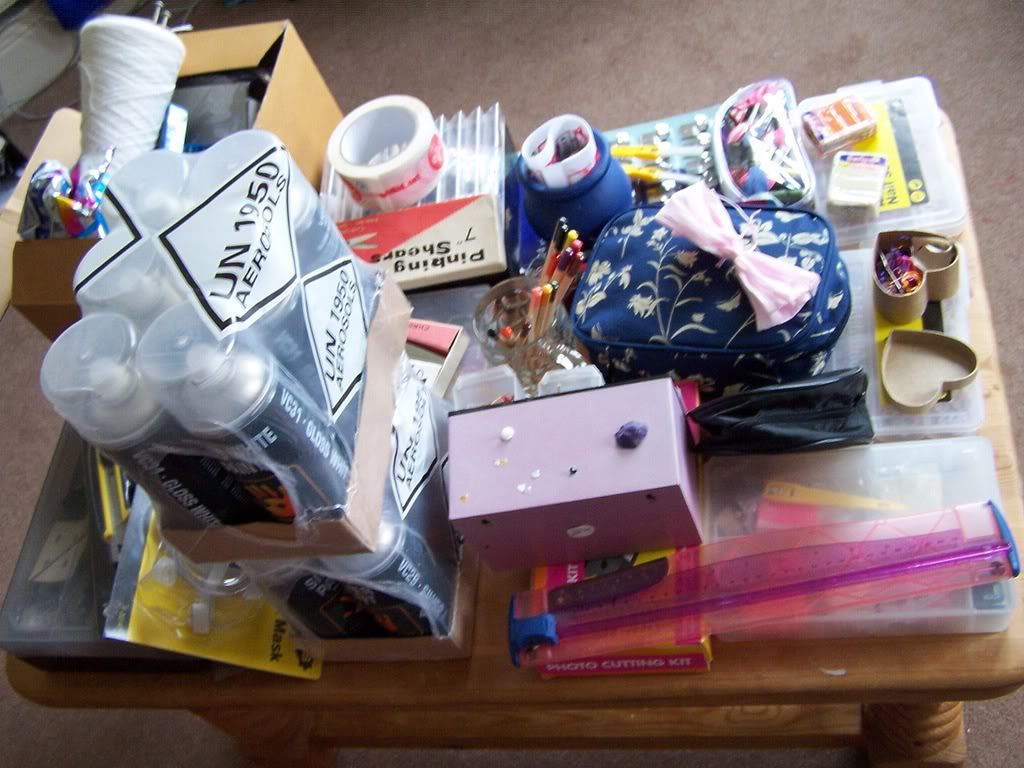 There it is, the shameful story - the story of my stash. (All right, not all of it. Most of it. Half of it. As much as I could grab when I took the photo okay?). I hadn't realised how much I'd bought over time, not at all. I was only inspired to find out and take this picture when I was adding up the figures for my upcoming first ever tax return. Month by month, page by page, I took away the provisional figures for my expenses away from the provisional figures for my turnover. And the result kept coming up red...
If I hadn't bought, oh, two thirds of this little lot, then the figure might have at least scraped into the black. And the thing is, I could still have made most of my inventory, while cutting my expenses that far.
Well, I think that's more than one lesson learned!
- Lesson 1: KEEP A ROUGH RUNNING BALANCE FOR YOUR INCOME AND EXPENSES and PROFIT. Don't just start plugging all the figures in at the end of the year!
I don't have to tell you, right? You've never been as dumb as that? Unfortunately, it appears I do have to tell ME! And not only that, but to act on it as well. From now on: I must know where my business finances stand. All the time, every time.
- Lesson 2: I CAN'T AFFORD TO BUY MORE STUFF: not till I'm back in the black, anyhow. Therefore: until that point, all craftiness must result from my EXISTING stash. Now there's a little jabbing demon, sticking a pitchfork into my calves to prod me into prodigious creativity. Yes! I am inspired!
Now: to not only learn these lessons, but to hold fast to them. I challenge myself, here and now.
Friday, 5 September 2008
It's a PROMO FRENZY all over the land!

So I've committed to contributing to two Etsy.com promo bag extravaganzas... what was I thinking of!!!
I want to make at least 25, preferably 50 items for each bag... but where do all the hours in the day go? So far I've made pitiful progress, and time is slipping away...
I think I just need to set myself a deadline. Whatever I've come up with by that date is what I'm sending off. That should light a fire under me... hopefully.
Today, instead of crafting, I:
i) made headway with my accounts
ii) attended an interview (arrrgggh)
iii) ate fast food (naughty)
iv) drank coffee (v. naughty)
v) drank wine, ate sweeties and had an online social networking blitz (hello Facebookywooky and Flickr)
Friday, 22 August 2008
functional depression
It's important to be productive, to produce. And especially when you're unemployed... Despite the name of this blog, it wouldn't be good to wind up curled on the sofa, cuddling a cuppa and staring slackly at Cash In The Attic on the box.
But it's hard. I always seem to find that, after the first few happy, relaxed days of underemployment, depression starts making little nibbles at my psyche, followed by big chomping gulps. I guess it's partly just because you have time to think about things, time you don't have when sucked into the 9 to 5. Bad things, often.
And partly the awareness that, fuck, you're unemployed. 1st bad thing: you're either claiming benefits and getting continuous hassle from the state about it, or you're running down your financial resources with no fairy godmother in sight. 2nd bad thing: this state will eventually end - when you get a goddamn J-O-B!
So, unemployment is synonymous with depression for me. Just as employment is synonymous with anxiety. Aah, I run the gamut of psychological malaise from.... well, A to B, I suppose, much like Katharine Hepburn and acting. Mania, schizophrenia, all those exotic and enticing variants... not so much.
I find the way to manage this state is bite-size functionality. Not an original idea, but put it into practice and it's a wonderful thing. However glum, slack-jawed and negative I might be, I find I can knock off one thing on my to-do list for at least 5-15 minutes. As long as I can then put the kettle on and collapse on the sofa for another 10 mins. Rinse, wash, repeat...
This way... maybe I'm half as productive as if I was working flat out. But ask yourself... is that really going to ever happen? Or am I in fact 1000% as effective as I would be if I wasn't employing this technique, and instead allowing stress and depression and the demand for continuous activity and immediate results to freeze me into stasis?
Things are getting done. Bit by bit, they're getting done.
But it's hard. I always seem to find that, after the first few happy, relaxed days of underemployment, depression starts making little nibbles at my psyche, followed by big chomping gulps. I guess it's partly just because you have time to think about things, time you don't have when sucked into the 9 to 5. Bad things, often.
And partly the awareness that, fuck, you're unemployed. 1st bad thing: you're either claiming benefits and getting continuous hassle from the state about it, or you're running down your financial resources with no fairy godmother in sight. 2nd bad thing: this state will eventually end - when you get a goddamn J-O-B!
So, unemployment is synonymous with depression for me. Just as employment is synonymous with anxiety. Aah, I run the gamut of psychological malaise from.... well, A to B, I suppose, much like Katharine Hepburn and acting. Mania, schizophrenia, all those exotic and enticing variants... not so much.
I find the way to manage this state is bite-size functionality. Not an original idea, but put it into practice and it's a wonderful thing. However glum, slack-jawed and negative I might be, I find I can knock off one thing on my to-do list for at least 5-15 minutes. As long as I can then put the kettle on and collapse on the sofa for another 10 mins. Rinse, wash, repeat...
This way... maybe I'm half as productive as if I was working flat out. But ask yourself... is that really going to ever happen? Or am I in fact 1000% as effective as I would be if I wasn't employing this technique, and instead allowing stress and depression and the demand for continuous activity and immediate results to freeze me into stasis?
Things are getting done. Bit by bit, they're getting done.
Monday, 18 August 2008
I pay my rent with Ebay
...so what's next?
After tax, anyhow, that's pretty much all my Ebay income is going to cover at the moment. It's not a lot, but it's a start, I suppose. Better than not covering the rent. Progress requires pushing on to the next level: e.g. covering my half of the monthly diesel costs for our crappy little motor, as well.
That'll be another £60 a month required, then.
How to do it, that's the question. Storing enough stock to start to multiply my Ebay earnings would entail renting out a little storage unit.
Cost: £80 a month, minimum. Not currently an option, then.
Other options? I think I'm looking at the Etsy route: develop a crafty little product that's quick to make and easy to store. Stackable, preferably...
Either that or scouring Craigslist or gumtree.com, looking for cheaper storage in someone's boxroom or garage or shed... till they do a flit / their teenage son leans his leaky motorbike on my boxes / the shed gets flooded.
Positive thinking is a wonderful thing!
After tax, anyhow, that's pretty much all my Ebay income is going to cover at the moment. It's not a lot, but it's a start, I suppose. Better than not covering the rent. Progress requires pushing on to the next level: e.g. covering my half of the monthly diesel costs for our crappy little motor, as well.
That'll be another £60 a month required, then.
How to do it, that's the question. Storing enough stock to start to multiply my Ebay earnings would entail renting out a little storage unit.
Cost: £80 a month, minimum. Not currently an option, then.
Other options? I think I'm looking at the Etsy route: develop a crafty little product that's quick to make and easy to store. Stackable, preferably...
Either that or scouring Craigslist or gumtree.com, looking for cheaper storage in someone's boxroom or garage or shed... till they do a flit / their teenage son leans his leaky motorbike on my boxes / the shed gets flooded.
Positive thinking is a wonderful thing!
Subscribe to:
Posts (Atom)
